Service
Rodent Control
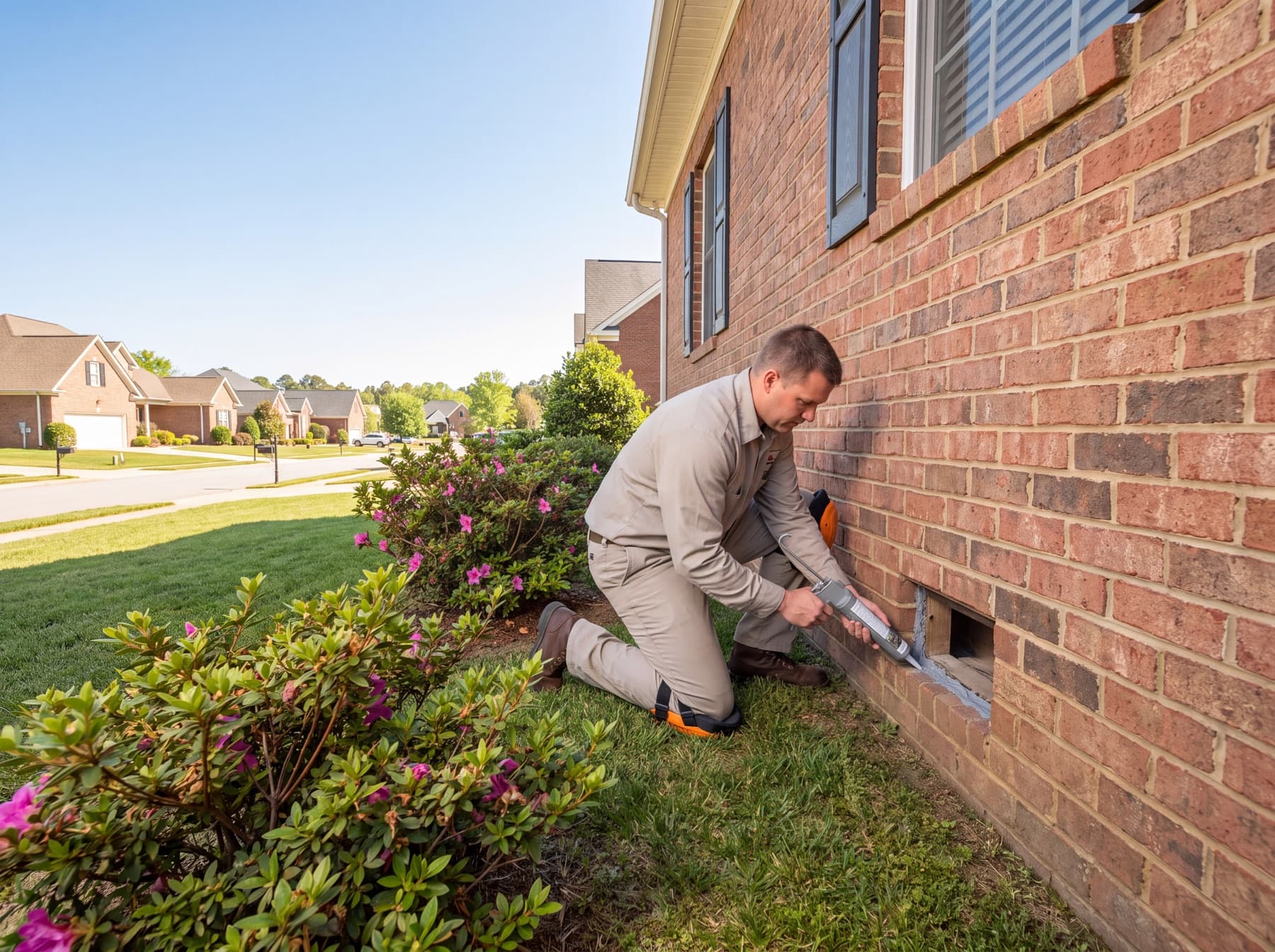
Mice and rat removal for attics, crawlspaces, and wall cavities across the Triangle. We start by finding and sealing the actual entry points instead of only setting traps, then handle removal and cleanup so the problem doesn't resurface.
A mouse or rat looking for a way inside doesn't care whether the house is a crawlspace bungalow near Oakwood or a slab-built home out toward Knightdale — it's after the same three things every time: food, warmth, and an opening big enough to squeeze through. Because rodents move at night and stay hidden inside walls and attics by instinct, most homeowners don't clock a problem until the evidence has already piled up.
Signs You Actually Have a Rodent Problem
Droppings tend to be the first clue anyone notices. Mouse droppings are small, smooth, and pointed at the ends — about 1/8 to 1/4 inch — and show up in kitchen cabinets, under sinks, along baseboards, or inside chewed-open cardboard. Rat droppings run larger, shiny black, and closer to 1/2 to 3/4 inch. Fresh droppings look dark and slightly moist; older ones dry out, lighten to gray, and crumble when disturbed, which is a rough but useful way to gauge how long activity has been going on.
A few other signs worth checking for:
- Gnaw marks — rats leave marks around 1/8 inch, mice leave something smaller and scratchier. Either can chew through cardboard, plastic, or wiring behind a wall, and chewed wiring is a genuine fire risk, not just cosmetic damage.
- Scratching or scurrying sounds, usually worse after dark. Rats tend to be heard higher up — attics, roof lines, ceiling voids — often with an audible gnawing sound, while mice are more commonly heard inside wall cavities, identified by a higher-pitched squeak.
- Grease smudges along baseboards and walls, left by the same rodents repeatedly using the same travel path along a surface.
- Nesting material — shredded paper, insulation, fabric, or packing debris balled up somewhere undisturbed, like the back corner of an attic or behind boxes that haven't been moved in a while.
DIY Traps vs. a Professional Rodent Program
A snap trap or a bait station from the hardware store can handle a single mouse that wandered in once, but the approach runs out of road fast for anything beyond that. Neither reaches rodents already nesting in wall cavities or attic insulation, and rats specifically are smart enough to start avoiding a trap after watching — or smelling — one catch another rat. A handful of traps in the kitchen might thin out what you're seeing without touching the nest that keeps producing more.
Professional rodent control works from two angles instead of one:
- Exclusion — locating and permanently closing off every gap a rodent could use to get inside. This is the part that actually stops the cycle, since mice fit through a dime-sized gap (about 1/4 inch) and rats need only a quarter-sized opening (about 1/2 inch). Vents, utility line penetrations, foundation gaps, and warped soffits account for most entry points on Triangle homes.
- Targeted trapping, placed based on an actual inspection of droppings, gnaw marks, and grease trails rather than a guess, followed by a return visit to confirm the problem is genuinely resolved and not just quieter for a week.
Key takeaway
Trapping without sealing the entry point treats the symptom, not the cause — the next mouse or rat will simply use the same gap the last one did. A rodent job that skips exclusion work is a temporary fix at best.
Attic Entry Points Are Different From Crawlspace Entry Points
Where the rodents are getting in usually points straight to the fix. Attic activity most often traces back to roofline problems — warped fascia, a gap where a tree limb overhangs the roof, or soffit vent screening that's torn or missing. In tree-heavy areas like Wendell, Wake Forest, and parts of Chapel Hill, mature canopy close to a roofline gives rats an easy branch-to-roof path that a ground-level walkaround alone will miss entirely. Crawlspace activity, more common in Raleigh's older pier-and-beam neighborhoods around Five Points and Oakwood, usually comes down to foundation vent screening that's failed, a gap around a plumbing penetration, or a crawlspace door that never sealed tightly to begin with.
Because the entry points differ so much by location, a real inspection checks both areas specifically rather than assuming one fix solves everything — a single home can have unrelated rodent activity going on in the attic and the crawlspace at the same time, entering through two completely different gaps.
What Rodent Control Costs
Basic extermination — traps or bait for mice or rats without exclusion work — usually runs $150 to $550. Full exclusion, the part that actually keeps rodents from coming back, costs more and scales with the scope of the job:
- $25 to $75 per entry point when it's priced piecemeal for a small, contained issue.
- $250 to $1,000 for a flat sealing job on a smaller home with limited access points.
- $600 to $1,500 or more for a larger home with several entry points or confirmed attic activity.
- $500 to $3,000 or more for a full-home seal on an older or larger property — crawlspace foundations take more labor to seal fully than a slab does, which pushes the price up.
A comprehensive plan — exclusion work plus a follow-up visit to confirm everything is holding — typically lands in the $600 to $1,400 range for a standard single-family home, and it's usually the better long-term value over paying for repeated trapping-only visits that never touch how the rodents got in.
How Often Rodent Control Is Actually Needed
Unlike quarterly general pest control, most Triangle homes don't need standing rodent service on a recurring schedule. Rodent work is typically project-based — an inspection, exclusion, and trapping to clear whatever's active, followed by a warranty period rather than an ongoing visit calendar. The exception is a home with known vulnerabilities: an older crawlspace foundation, mature trees close to the roofline, or a documented history of past activity. Those homes sometimes add a rodent check onto their regular quarterly pest visit as cheap insurance against a repeat problem.
Frequently Asked Questions
How fast can you actually get rid of mice? Visible activity usually drops within days of the first visit. Full resolution — including sealing entry points — typically takes one to two weeks, since exclusion work and confirming the seal is holding take a bit longer than the initial trapping.
Can mice come back after exclusion work is done? Only if a new gap opens up somewhere or a previous seal fails, which is uncommon when the work is done thoroughly and verified on a follow-up visit. A properly excluded home should stay that way barring new damage to the structure itself.
How do you get rid of the smell after mice are gone? Removing droppings, nesting material, and any deceased rodents, followed by an enzyme-based cleaner on affected areas, usually clears the smell within a few days. A smell that lingers well past that point often means there's a dead rodent somewhere inaccessible, like deep inside a wall cavity or duct.
Do ultrasonic rodent repellers actually work? Not reliably. There's no consistent evidence they reduce activity, and rodents tend to habituate to the sound fairly quickly. They're not a substitute for actual exclusion and trapping, whatever the packaging claims.
Where We Offer Rodent Control
What Homeowners Look For
A few things customers consistently tell us matter most.
Frequently Asked Questions
Ready to get this fixed?
Call now or request a free estimate — we'll get back to you fast.